

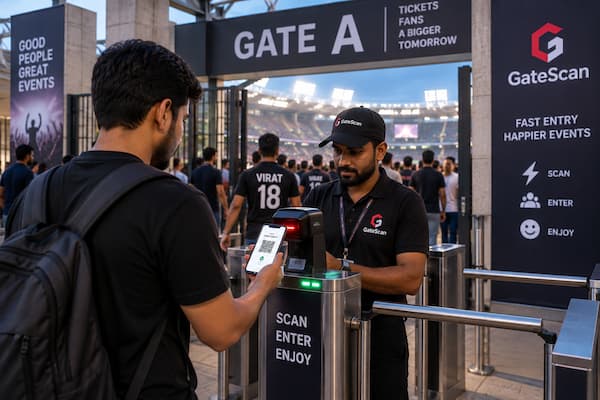
Introduction
No venue tests an entry system like a stadium does. Instead of a few hundred guests arriving over an evening, a stadium has to move tens of thousands of fans through a fixed number of gates in the hour before kickoff, all while running security screening at the same time. Get it wrong and the result is a queue stretching around the block, fans missing the opening minutes, and a genuine crowd-safety risk outside the gates.
Fast stadium entry is not really about scanning tickets quicker — most modern systems can already do that in a second or two. It is about designing the whole approach: how many gates, how they are assigned, how security screening fits alongside ticket checks, and how staff handle the moment something does not go smoothly. This guide walks through what makes stadium entry uniquely hard, and a practical approach to fixing it.
Why Stadium Entry Is Different From Other Venues
A concert hall or conference center can usually let guests trickle in over an hour or two. A stadium rarely has that luxury:
- Massive concentrated arrival. A large share of the crowd tries to get in in the 30 to 60 minutes before kickoff, creating a volume spike no other venue type sees at this scale.
- Security screening is mandatory, not optional. Bag checks, walk-through metal detectors, and prohibited item searches sit on top of ticket verification, effectively doubling the checks each fan goes through.
- Multiple ticket types at once. Season ticket holders, single-match buyers, premium and hospitality guests, accessible seating, and staff or media all need to move through the same gates, often with different requirements.
- Re-entry is common. Fans who step out for any reason need to be verified again without being treated as a brand new arrival.
- Outdoor queuing is exposed. Weather, lighting, and open-air crowd density all affect how a queue behaves in ways an indoor lobby does not.
The Core Bottlenecks at Stadium Gates
Most slow matchday entries trace back to a small set of recurring problems:
- Manual ticket or ID checks at turnstiles, where staff have to visually confirm a printed ticket or search a name, adding seconds that compound fast at volume.
- Security screening treated as a separate queue from ticket verification, so fans effectively wait in line twice.
- Uneven gate distribution, where fans default to the gate nearest their usual parking or transit stop, overloading it while other gates sit underused.
- Printed tickets that are hard to scan in poor light, rain, or when creased and worn from being carried around.
- No fallback when hardware fails. A single turnstile scanner going down with no backup process stalls an entire lane.
Step-by-Step: How to Speed Up Entry at Any Stadium
Step 1: Move to Digital, Mobile-First Ticketing
Digital tickets delivered to a phone remove the single biggest source of delay: a physical item that can be lost, damaged, or hard to read. Fans arrive with a ticket that is already validated and ready to scan, rather than something staff need to inspect by eye.
Step 2: Use QR or Barcode Scanning at Every Turnstile
A QR or barcode scan takes a fraction of the time a manual check does, and it removes any need to search a list or squint at a printed name. Every gate should scan the same way, so data from every entry point feeds into one unified system.
Step 3: Assign and Communicate Gates in Advance
Print or display the assigned gate directly on the ticket, and send a reminder by email or SMS before matchday. Fans who already know which gate to head to do not bunch up at the one everyone defaults to.
Step 4: Separate Security Screening From Ticket Verification Where Possible
Where layout allows, run bag checks and metal detection as one motion alongside the scan, rather than as two sequential queues. A published clear-bag policy also reduces how often staff need to stop and inspect a bag in detail.
Step 5: Match Lane Count to Gate-Specific Demand
Not every gate needs the same number of lanes. Look at historical arrival patterns by gate and staff accordingly, rather than spreading resources evenly across gates that see very different volumes.
Step 6: Train Gate and Security Staff Together
Ticket scanning and security screening are usually run by different teams, but fans experience them as one process. Joint training on handling exceptions — an invalid scan, a flagged bag, a name mismatch — keeps a single unusual case from stalling the whole lane.
Step 7: Monitor Entry Rates by Gate in Real Time
A live view of scan rates per gate lets stadium operations spot a slowing gate in the moment and redirect staff, open an extra lane, or push a message to fans still en route, instead of finding out only once the queue outside is already long.
How QR-Based Ticketing Speeds Up Stadium Turnstiles
QR tickets solve several matchday-specific problems at once:
- Speed at volume. A scan takes about a second, which matters enormously once tens of thousands of fans are trying to enter within the same short window.
- Works across formats. The same code functions whether it is shown on a phone, printed at home, or issued as part of a season ticket pack.
- Fraud and duplicate detection. Season tickets and high-demand matches are prime targets for screenshotted or resold passes. A unique code flags a second scan attempt immediately, which a manual check at a turnstile has almost no chance of catching in a moving crowd.
- Consistency across every gate. Because every turnstile checks against the same system, a ticket already used at one gate is instantly recognized if tried again at another.
Managing Security Screening Without Creating a Second Bottleneck
Security cannot be shortened for the sake of speed, but it can be designed so it does not double the wait. A few approaches that help:
- Publish a clear-bag or no-bag policy well in advance so fans arrive already compliant, reducing how often a bag needs a detailed search.
- Position the ticket scan and the walk-through detector in sequence at the same lane, rather than as two separate queues with their own staff and their own bottleneck.
- Give security staff visibility into the same real-time gate data as ticketing staff, so both teams are reacting to the same picture of where volume is building up.
Coordinating Multiple Gates and Re-Entry
Running several gates only works smoothly if they are not operating as separate silos:
- One shared verification system across every gate means a ticket used anywhere is recognized everywhere, with no risk of the same seat being let in twice through different entrances.
- A defined re-entry process, whether that is a re-scan of the original code or a wristband issued at first entry, so fans stepping out briefly are not treated as new arrivals.
- Anomalies flagged instantly, such as the same ticket being scanned at two different gates within minutes, which is exactly the kind of pattern a manual process struggles to catch.
How GateScan Supports Fast Stadium Entry
GateScan, powered by MediaDost, is built around the same operational layer that determines whether a matchday gate runs smoothly:
- A shareable registration and ticketing link for season passes and single-match sales, keeping every booking in one system instead of scattered across channels.
- Digital QR ticket generation, with the option to print the same code for fans who prefer a physical pass.
- Fast QR-based check-in using a phone camera, so adding an extra lane at a gate is as simple as adding another device.
- Automatic duplicate detection, flagging a season ticket or match ticket the moment it is scanned a second time at any gate.
- A live dashboard across every gate, giving operations a single, real-time view of entry rates instead of separate counts from each entrance.
What Fast Stadium Entry Looks Like on Matchday
Venues that tighten up their entry process typically see:
- Pre-kickoff queues that clear well before the whistle instead of stretching past it.
- Far fewer disputes over lost, damaged, or duplicated tickets.
- A real-time, gate-by-gate view of how many fans have actually arrived.
- Security and ticketing staff working from the same picture instead of two disconnected queues.
Getting Started
If matchday queues are a recurring headache, the fix is rarely about hiring more gate staff. It usually comes down to removing the steps that make each entry slow in the first place and giving every gate the same real-time visibility. Reach out for a walkthrough of how GateScan can be set up for your venue:
Phone: +91 99422 22304
Email: support@gatescan.in