
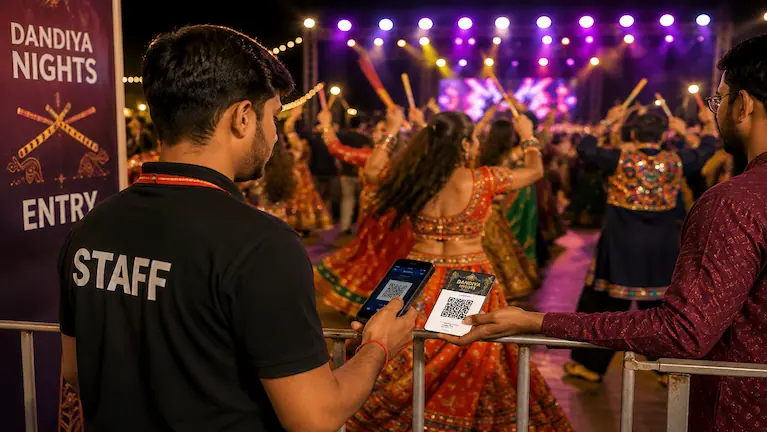
Dandiya Night event management comes with a specific set of pressures most festival organizers only fully understand after they've run one. Unlike a seated concert or a exhibition, a dandiya night is built around continuous, high-energy participation — most of the crowd isn't watching from the sidelines, they're on the floor, sticks in hand, moving in circles for hours. That changes how ticketing, entry, and crowd flow need to be planned.
Get ticketing and entry right, and the night runs itself — people move through the gate quickly, the floor never feels dangerously packed, and your team spends the evening managing the show instead of managing a queue. Get it wrong, and even a well-promoted, well-attended event can start with an hour of frustrated guests stuck outside.
This guide walks through what makes dandiya night event management different from other festival formats, a practical step-by-step process for handling registration through entry, and where a QR-based system like GateScan fits into each stage — without adding complexity your team doesn't need.

What Makes Dandiya Night Event Management Different From Other Festival Events
A few characteristics set dandiya nights apart from a typical concert, exhibition, or corporate event, and they directly shape how ticketing and entry should be handled:
- Nearly everyone is a participant, not a spectator. Attendees need open floor space to dance in circles, which means overcrowding isn't just uncomfortable — it's a genuine safety concern.
- Ticket categories are more layered. Stag, couple, group, and season passes often run simultaneously, sometimes with different pricing for costume categories or stick-included packages.
- A large share of the crowd arrives in a short window. Most attendees want to be inside before the main performer or DJ set begins, so gate volume spikes hard in the first 30-45 minutes.
- Season passes carry real resale value. A pass covering multiple nights of a Navratri-season dandiya series is exactly the kind of ticket that gets photocopied, screenshotted, or resold if there's no way to verify it electronically.
- The event repeats. Many dandiya nights run across several evenings in a row, so whatever process you set up on day one needs to hold up night after night, not just survive a single evening.
Keeping these in mind is what separates a generic "event entry plan" from one that actually works for dandiya night event management specifically.
The Core Challenges Organizers Face at Dandiya Night Entry Gates
Before getting into solutions, it's worth naming the problems clearly, since most of them show up in some combination at nearly every dandiya event:
- Ticketing spread across multiple channels — bookings coming in through social media DMs, phone calls, and walk-ins, with no single place to see total sales.
- Gate pileups right before showtime, as manual verification (checking names, wristbands, or printed tickets) can't keep pace with a sudden rush of arrivals.
- Fake or duplicated tickets, particularly season passes, which are hard to catch by eye in a crowd.
- Confusion across multiple entry gates, when different gates handle different pass types without a consistent, unified way to verify and record entries.
- No real-time sense of how full the venue actually is, which matters both for guest experience and for basic crowd safety on a packed dance floor.
How to Manage Dandiya Night Entry: A Step-by-Step Process
This is the practical backbone of dandiya night event management — the sequence that takes an event from open registration to a smoothly running gate.
Step 1: Set Up Digital Ticketing and Registration
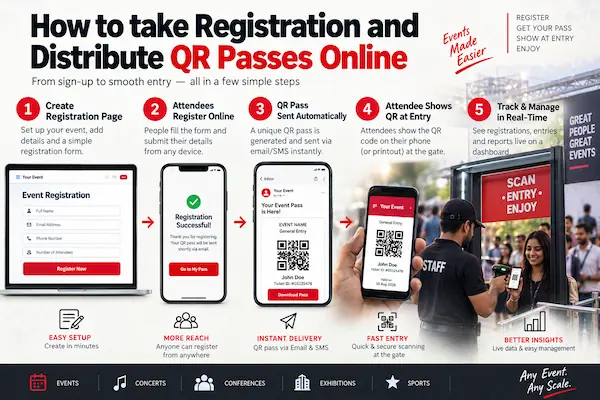
Move dandiya night registration away from scattered DMs and phone bookings into a single, centralized process. Set your pass categories upfront — single night, multi-night, stag, couple, group — and let attendees register and book directly through one shared link. This gives you one place to track total sales instead of reconciling numbers from five different sources after the fact.
Step 2: Distribute Tickets as QR Codes
Once a booking is confirmed, each attendee should receive a unique QR code tied to their registration — sent by email, WhatsApp, or SMS. This becomes their entry pass, and because it's generated per booking, it can't be casually copied the way a generic printed ticket design can. For attendees who'd rather have something physical, the same QR code can be printed instead; verification works the same either way.
Step 3: Plan Your Entry Gates and Lanes
Decide gate placement based on your expected pass mix. If you're running stag, couple, and season-pass categories, dedicated lanes for each — clearly signed — prevent staff from trying to visually identify ticket types on the fly. This is also the point to assign a lead at each gate who can handle exceptions without pulling attention away from the main queue.
Step 4: Verify Every Ticket with QR Scanning at Entry
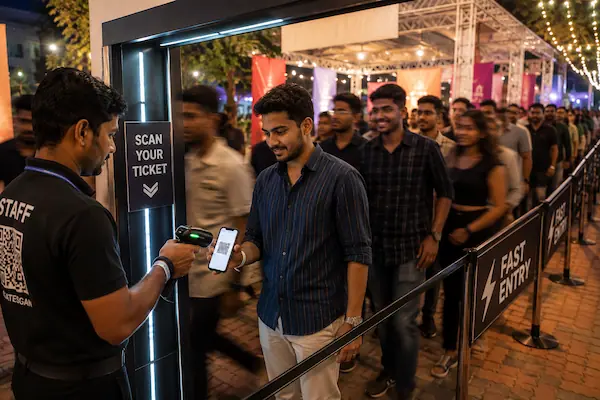
At the gate, staff scan each attendee's QR code using a phone camera. The code is checked against the registration database, and entry is approved or flagged in about a second — no manual list-checking involved. This is the step that determines whether your gate keeps moving or backs up once the pre-show rush hits.
Step 5: Monitor Attendance in Real Time
As scans happen, attendance data updates live, giving your team a running count of how many people are actually inside. For an event where the entire crowd is on the dance floor, this is far more useful than a rough headcount estimate — it lets you make real decisions about pacing entry if the venue is approaching capacity.
Step 6: Handle Walk-Ins Without Disrupting the Main Flow
Dandiya nights often see a meaningful number of walk-in attendees who didn't pre-book. Keep a separate lane or counter for on-the-spot registration so these guests don't slow down the line for people who already have their QR pass ready.
Step 7: Reconcile After the Event
Once the night wraps up, pull your attendance and sales data to reconcile bookings against actual entries. Across a multi-night dandiya series, this same report also tells you which nights, categories, or channels are performing best — useful for both your team and any sponsors involved.
How to Speed Up Entry at a Dandiya Night
The single biggest lever for faster entry is removing manual verification from the process entirely. A few specific tactics help:
- Send QR passes well before the event, not on the day itself, so attendees already have them saved and ready to show at the gate.
- Split lanes by pass category so staff aren't trying to distinguish stag from couple from group tickets by eye.
- Brief gate staff on the exception process — what to do when a scan is flagged — so a single unusual case doesn't stall the whole lane while someone figures out what to do.
- Avoid any step that requires cross-referencing a printed list. Even a well-organized spreadsheet check adds seconds per person that compound fast once a queue forms.
In practice, this is the difference between a manual check that takes 20-30 seconds per person and a QR scan that takes roughly a second — a gap that barely matters for the first few guests, and matters enormously once a few hundred are waiting.
How to Manage Crowd at a Dandiya Night Event
Crowd management at a dandiya night is less about the queue outside and more about what happens once people are on the floor. A few practical steps help:
- Track live occupancy as attendees enter, so your team has an actual number to work with rather than a visual guess.
- Pace entry if the floor is approaching capacity, rather than letting the gate keep admitting people regardless of how full the venue already is.
- Use clear signage and staff positioning to direct different pass holders to their designated lane, reducing the kind of gate-side confusion that causes crowding to build up at the entrance itself.
- Coordinate entry data with your security team, so they're working from the same real-time numbers your gate staff are seeing, instead of separate, disconnected estimates.
How QR Codes Help With Dandiya Night Entry
QR-based entry solves several dandiya-specific problems at once:
- Speed — a scan takes about a second, keeping lines moving even during the pre-show rush.
- Accuracy — there's no handwriting to misread or list to search through under pressure.
- Duplicate detection — since each code is unique to a single registration, a second scan of the same code is flagged immediately, which matters most for season passes that are worth reselling or sharing.
- Flexibility — the same QR code works whether it's shown on a phone screen or printed on paper, so attendees aren't forced into one format.
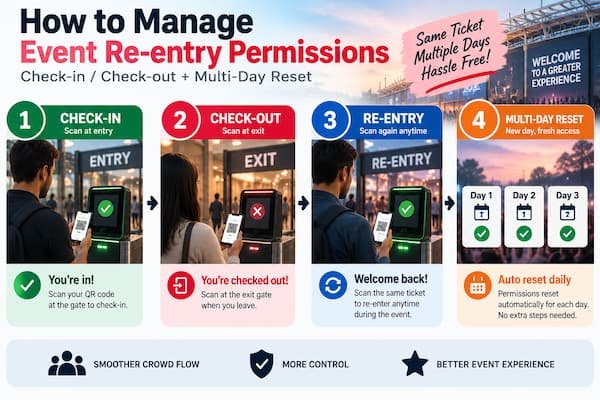
- Multi-gate consistency — every gate scanning against the same system means entries from different lanes all feed into one unified attendance count, instead of separate paper tallies that have to be added up later.
How to Manage Multiple Entry Gates at a Dandiya Night
Running more than one gate is often necessary for a dandiya night simply because of volume, but it introduces a coordination problem if each gate is working off separate records. A few things make multi-gate entry manageable:
- Assign each gate a clear purpose — by pass type, by arrival time slot, or by pre-booked vs. walk-in — so staff and attendees both know exactly where to go.
- Use one shared verification system across every gate, so a ticket scanned at Gate 2 is immediately recognized as used if someone tries the same code at Gate 4.
- Give each gate a lead who can escalate issues without needing to radio a central desk for every unusual case.
- Review combined attendance data centrally, rather than asking each gate to report a separate paper count at the end of the night.
Preventing Fake and Duplicate Tickets at Dandiya Events
Season passes and group tickets are the most common target for duplication simply because they're worth the most. A QR-based system addresses this directly: since each code is unique to one registration, scanning it a second time — whether it's a screenshot shared with a friend or a photocopy of a printed pass — gets flagged the moment it's attempted again. This turns a problem that's nearly invisible to a manual check into something staff catch automatically, in real time, at the gate.
How GateScan Supports Dandiya Night Event Management
GateScan, powered by MediaDost, is built around the parts of this process that tend to break down when handled manually:
- A shareable registration link lets attendees book directly, with all registrations tracked in one place instead of scattered across channels.
- Digital QR ticket generation, sent automatically once a booking is confirmed, with the option to print the same code for attendees who prefer a physical pass.
- Fast QR-based check-in at the gate using just a phone camera, with no separate scanner hardware required.
- A live dashboard showing registrations, category breakdowns, and real-time attendance as scans happen.
- Automatic duplicate detection, flagging a QR code the moment it's scanned more than once.
- Support for multiple simultaneous entry gates, all verifying against the same shared data so attendance stays accurate across every lane.
None of this changes how a dandiya night is run creatively — it's aimed squarely at the operational layer: registration, ticketing, and entry, so your team can focus on the event itself.
What a Well-Run Dandiya Night Looks Like
When registration, ticketing, and entry are handled through one connected process, organizers typically see:
- A pre-show rush that clears in minutes instead of stretching into a long backup at the gate.
- Far fewer disputes over passed-back, screenshotted, or copied tickets.
- A real number for how many people are on the floor, rather than a guess.
- One consolidated report at the end of the night — or the season — instead of manually adding up separate gate counts.
Getting Started
If you're organizing a dandiya night — whether it's a single evening or a full Navratri series — and want registration, ticketing, and entry running through one system instead of several disconnected ones, GateScan is built to set up before the event and hold up across every gate and every night. Reach out for a walkthrough tailored to your event:
Phone: +91 99422 22304 Email: support@gatescan.in