
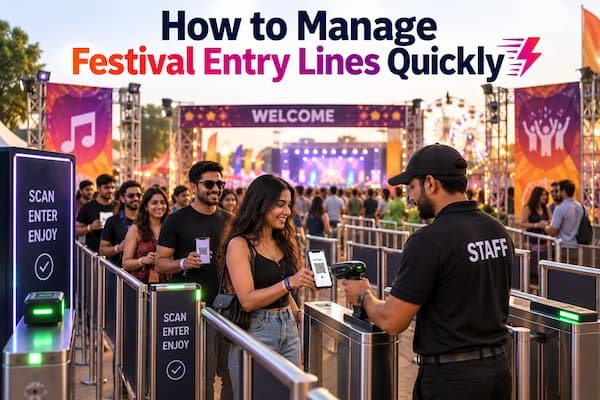
Festival entry lines move quickly when three things happen together: tickets are verified with a fast QR scan instead of a manual wristband exchange, lines are split by ticket tier so a VIP or single-day pass is not stuck behind a full weekend crowd, and bag checks run alongside scanning rather than as a separate queue. Reusing the same digital pass for every day of the festival also removes the need to re-verify attendees from scratch each morning.
Why Festival Entry Lines Move Slower Than Other Events
A festival gate deals with problems a single-evening concert or conference rarely faces:
- No fixed arrival time. With general admission and no assigned seating, fans arrive whenever they choose, which creates unpredictable surges rather than a steady flow.
- Wristband conversion at will-call. Many festivals still require attendees to exchange a printed or digital ticket for a physical wristband at a separate booth before they can even reach the actual entry gate.
- Multiple ticket tiers through the same gates. Single-day passes, weekend passes, VIP, and camping access all need different handling, but often funnel through the same lines.
- Bag checks and prohibited item searches. Outdoor festivals commonly screen for alcohol, outside food, and other restricted items, adding a second check on top of ticket verification.
- Open-field, outdoor conditions. Uneven terrain, weather, and long walks from parking or transit all affect how a queue behaves compared to an indoor lobby.
The Biggest Bottlenecks in Festival Entry Lines
- Converting a ticket into a wristband on site. This extra step, done manually at a booth, is often the single slowest part of festival entry, well before anyone reaches the actual gate.
- One line handling every ticket type. Staff having to visually sort single-day, weekend, and VIP passes at the same lane slows everyone down.
- No visibility into which lane is backing up. Without real-time data, organizers only notice a slow gate once the queue outside is already long.
- Bag checks stacked behind ticket scanning instead of happening at the same time, effectively doubling the wait.
Step-by-Step: How to Manage Festival Entry Lines Quickly
Step 1: Skip the Wristband Conversion Bottleneck With QR-Only Entry
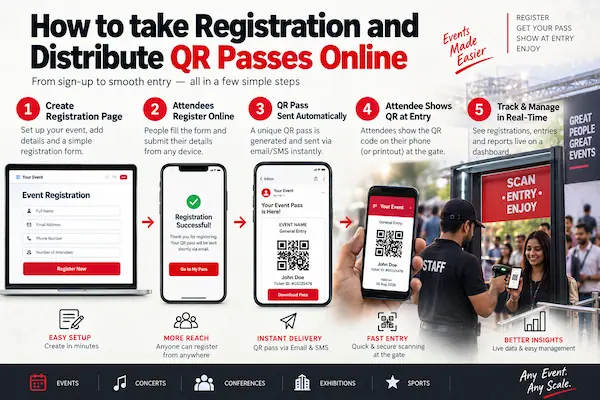
Rather than exchanging a ticket for a wristband at a separate booth, let the original QR pass work directly at the gate. This removes an entire extra step and an entire extra queue that most festivals do not actually need.
Step 2: Split Lines by Ticket Tier
Give single-day, weekend, VIP, and camping passes their own clearly signed lanes. This stops staff from having to visually identify ticket types on the fly and keeps a slower-moving tier from backing up a faster one.
Step 3: Spread Arrivals With Time-Banded Entry Windows
Where possible, stagger entry times across ticket tiers or communicate suggested arrival windows in advance, so the entire crowd is not aiming for the exact same half hour before the first act.
Step 4: Run Bag Checks Alongside Scanning, Not Before It
Position ticket scanning and security screening at the same point in the lane, so a fan is not standing in one queue for a bag check and then another for the ticket scan.
Step 5: Add Mobile or Roaming Scan Staff for Peak Surges
During the heaviest arrival window, a few staff with handheld scanners working the edges of the queue can pull people through faster than waiting for them to reach a fixed lane.
Step 6: Give Gate Staff Live Visibility Into Line Speed
A real-time view of scan rates per gate lets organizers catch a slowing lane early and shift staff or open another lane before the backup becomes visible from outside the venue.
Step 7: Reuse the Same Pass Across Every Festival Day
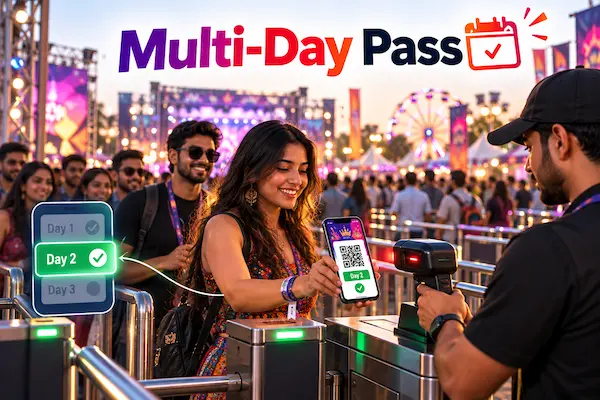
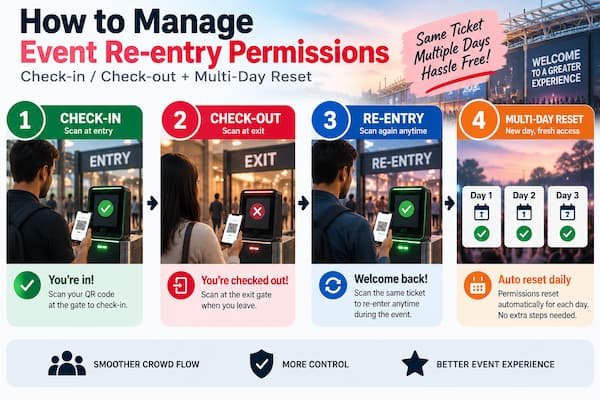
For multi-day festivals, attendees should not need a new pass each morning. The same digital ticket should carry across all festival days, so re-entry each day is a fast re-scan rather than a fresh verification.
How QR-Based Entry Removes the Will-Call Bottleneck
The wristband exchange booth exists mainly because paper and printed tickets are hard to verify quickly and hard to make tamper resistant on their own. A QR-based digital pass solves both problems directly:
- No physical exchange needed. The same code sent to a phone, or printed once, works at the gate without a separate conversion step.
- Fast verification at scale. A scan takes about a second, compared to the several minutes a manual wristband exchange can take per attendee during a rush.
- Duplicate detection built in. A unique code flags itself the moment it is scanned a second time, which matters for high-value weekend and VIP passes that are worth reselling or sharing.
How GateScan Supports Fast Festival Entry
GateScan, powered by MediaDost, is built around removing exactly these festival-specific delays:
- Digital QR passes that work directly at the gate, removing the need for a separate wristband conversion booth.
- Fast scanning using just a phone camera, so adding an extra lane or a roaming scanner during peak arrival is as simple as adding another device.
- Automatic duplicate detection across ticket tiers, flagging a reused pass the instant it is scanned again.
- Multi-day ticket support, so the same pass carries across every day of the festival instead of needing to be reissued each morning.
- A live dashboard across every gate, showing real-time entry rates so organizers can react to a slowing lane as it happens.
What Fast Festival Entry Looks Like in Practice
Organizers who tighten up festival entry typically see queues that clear well before the first act starts, far fewer disputes over shared or duplicated wristbands, and a real-time view of exactly how many attendees have entered across every gate and every day of the event.
Getting Started
If will-call lines and gate backups are a recurring problem at your festival, the fix usually starts with removing the wristband conversion step entirely rather than adding more staff to manage it. Reach out for a walkthrough tailored to your event:
Phone: +91 99422 22304
Email: support@gatescan.in